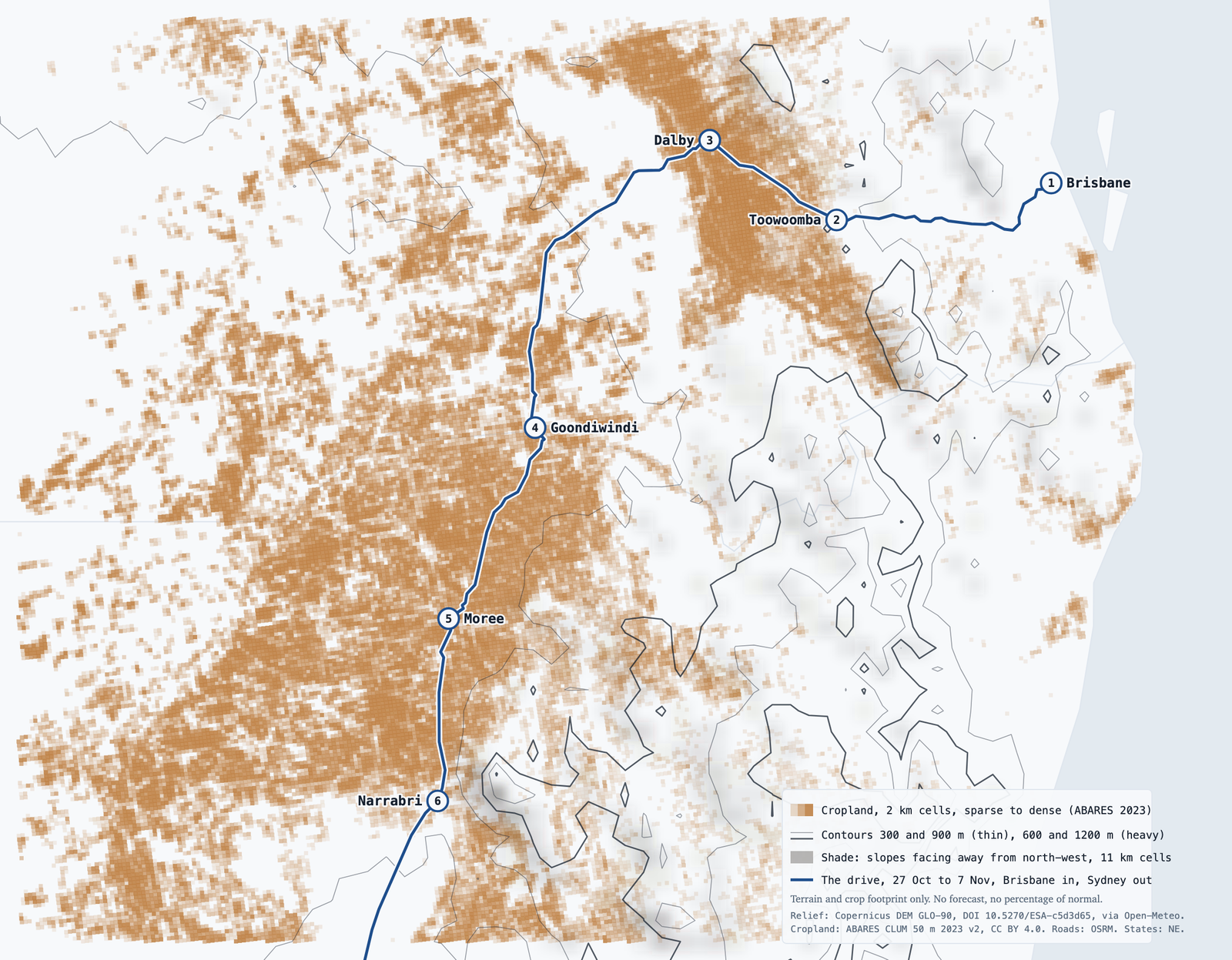
Dispatch 02 · On the Raggedy Edge · September 2026
There is a line across eastern Australia with a failed winter grain harvest on one side of it and one of the best seasons on record on the other. Between 27 October and 7 November I will drive across it, Brisbane to Sydney by the inland road, with a camera. This dispatch follows three stories that moved in the first three weeks of September, each from the document that started it to the one that most recently changed it. The crop, the crews who cut it, and the ocean that is being blamed for both.
1. The crop: a line, and then the rain stopped
On the first of September the national forecaster revised Australia's winter crop up twelve per cent, to 61 million tonnes, the fourth largest on record, because South Australia, Victoria and southern New South Wales did better than anyone expected. In the same report Queensland went the other way, down forty-four per cent to 2.2 million tonnes and a further nine per cent below June.1 The winter crop is the wheat, barley and chickpeas sown in autumn and cut in spring. New South Wales is where the line runs, so its own figure, one average over a failed north and a good south, says nothing either way. ABARES' words for the north are "well below average soil moisture levels across much of northern New South Wales."2
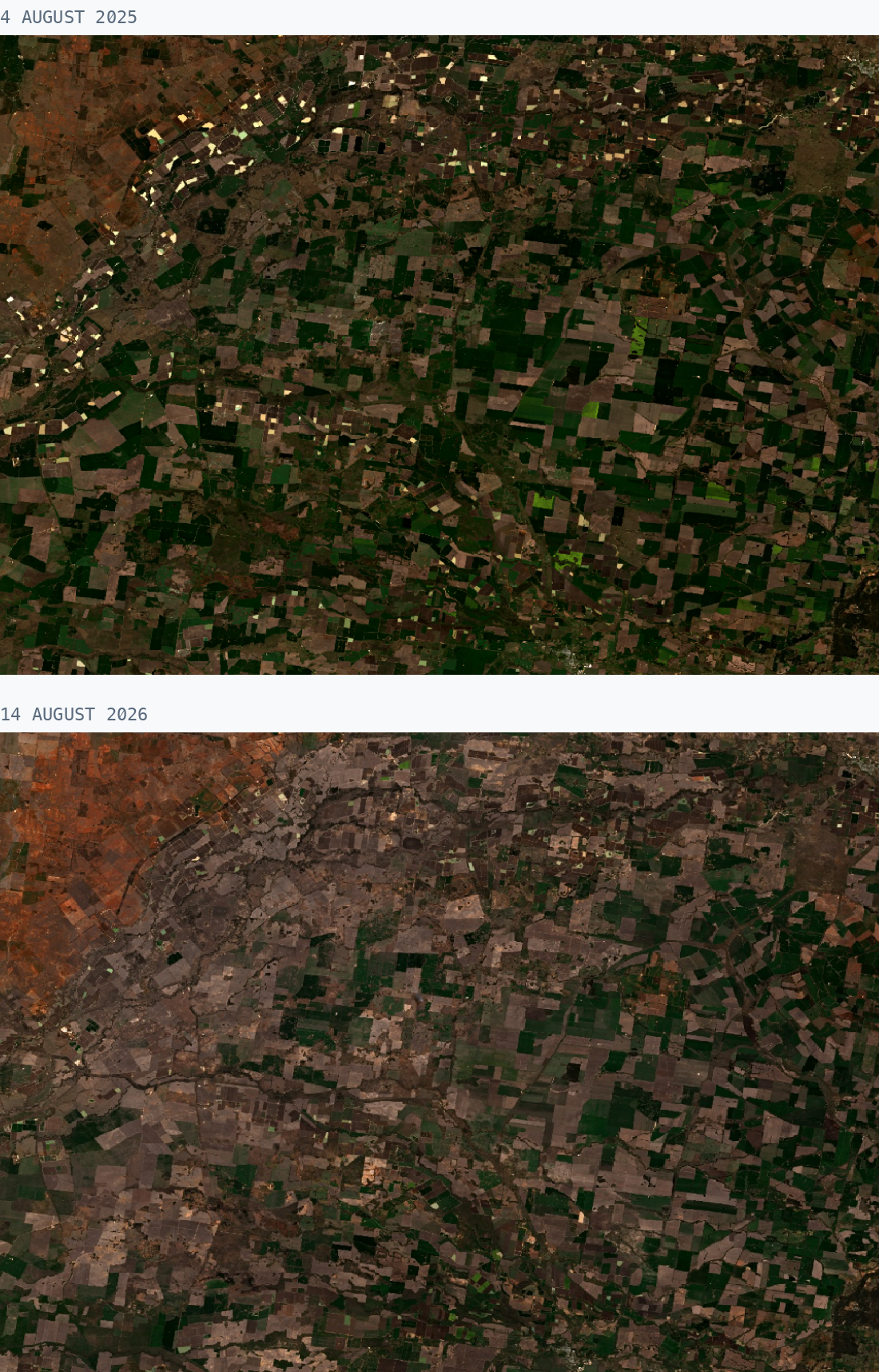
The same week a Goondiwindi broker gave the trade press the line in one sentence. The Queensland crop deteriorates week on week, Gerard Doherty told Grain Central, and "once you get over the border, it improves with every kilometre south you go."3 Then a hot weekend, thirty degrees with drying wind, and the column of 14 September recorded that crops west of the Inner Downs with no moisture beneath them had "lost" yield potential, and that stressed crops "could well be grazed or baled while they still have some biomass."4
On 16 September the satellites put figures on the area. Digital Agriculture Services, which counts crop over a million paddocks from orbit, has Queensland's wheat area down thirty-nine per cent and New South Wales' down twenty-five, against South Australia, whose crop was up and growing four weeks ahead of anything in its records.5
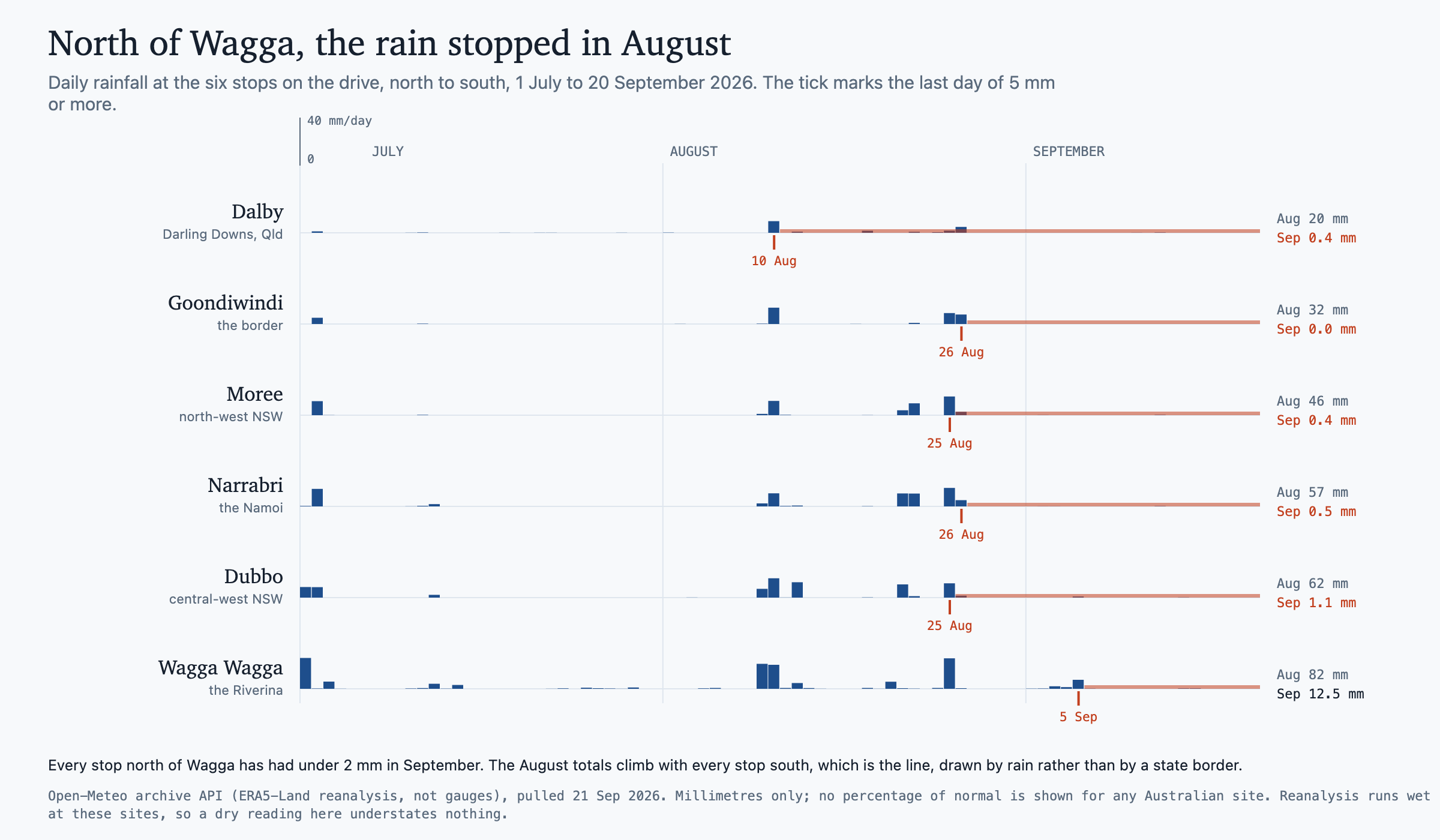
And on the 17th a Stewart Grain trader, Robert Quinn, said what the north's growers had stopped saying to buyers: "Crops here are going backwards; they needed a drink and they didn't get it."6 The northern harvest, Liz Wells wrote, "will get cracking in earnest in southern Queensland by early October," and it is "expected to be a fast one," with contract harvesters and carriers "pushing south for work as soon as they can." Sorghum, the summer grain, is already going into northern New South Wales ground on whatever moisture is there. The same day ABARES' weekly update recorded "little to no rainfall ... across cropping regions in Queensland, and central and northern New South Wales," and a dry eight days ahead for every eastern cropping region.7
The weather record agrees, and it draws the line better than a state border does.
What none of the documents say is what the ground looks like, and that is the part I can do.
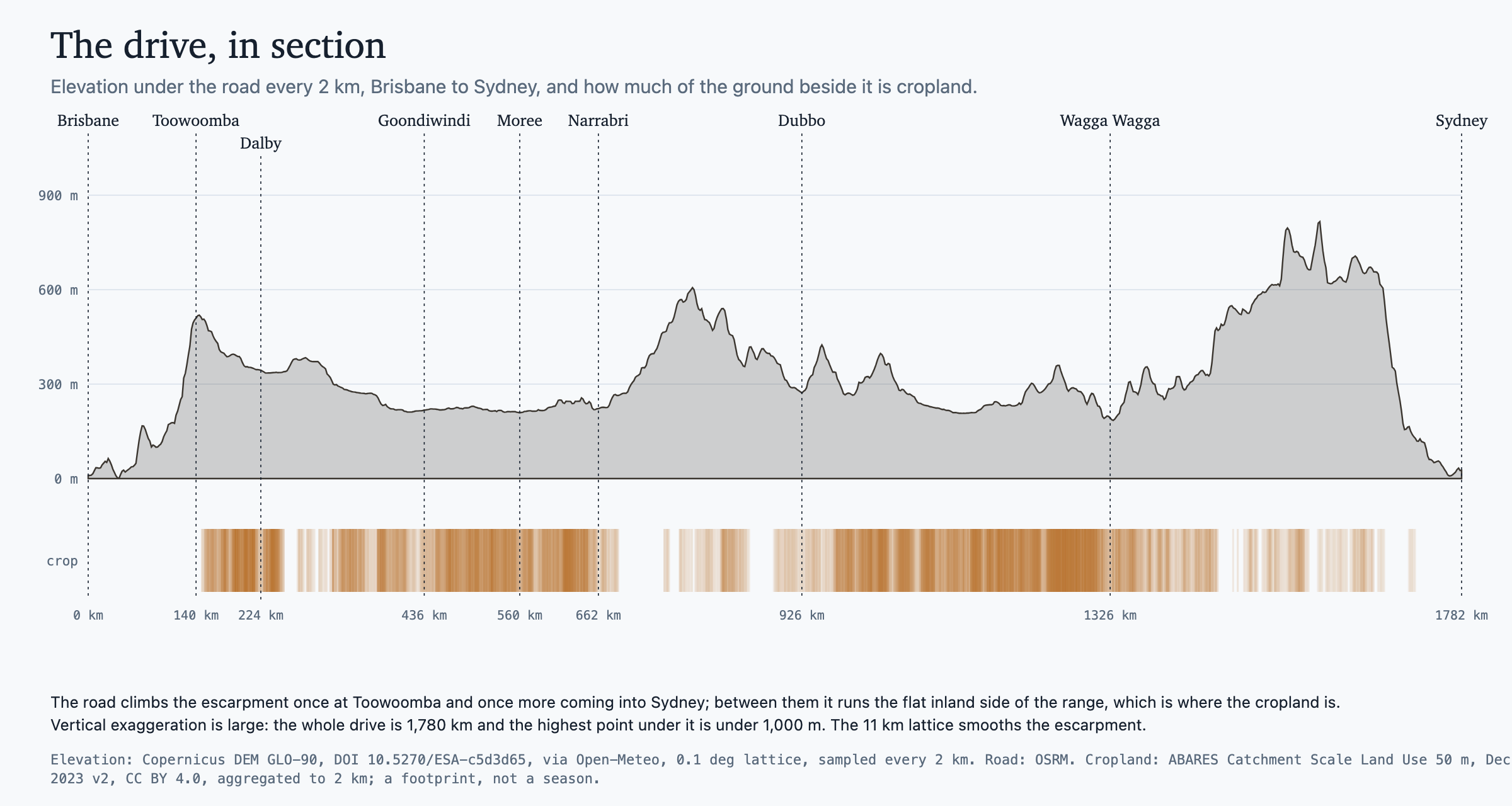
A word on the ground itself, because the map most people carry of eastern Australia is the coast. The Great Dividing Range runs the length of it, a hundred to two hundred kilometres inland, and the grain belt is on the far side. The drive crosses the range twice: up the escarpment at Toowoomba on the first day, and back over it coming into Sydney on the last. Everything between, Dalby to Wagga, is the flat inland run where the wheat is, and the line this dispatch is about is drawn across that run, not through the mountains.
2. The crews: two visas, and then a speech
The harvest in Australia is cut largely by contractors, businesses that own the headers, the combine harvesters, and move south with the ripening crop. Their crews come from overseas, on two kinds of visa: the working-holiday visa that most backpackers arrive on, and the skilled visa for operators who can run a half-million-dollar machine.
On 24 August the contract-harvesting association's president, Matthew Bourke, told Grain Central that he employs more than thirty people, over half from the United Kingdom and North America, and that not one of the visas his returning crew lodged in July had been approved. "I'm concerned it'll be mid-October and we'll be waiting for approval."8
The trade press tied that to a ministerial direction of 24 July that reorders skilled-visa processing behind police, defence, health, teaching and housing.9 I read the direction. It covers the skilled classes and nothing agricultural appears in it. It does not touch the working-holiday visa. That one was slowed by a separate decision, taken in August, to pause first applications from two dozen countries and process people already in Australia ahead of those applying from abroad. The department's own words: "finalising some offshore WHM visa applications may take several months."10 Which visa a crew is waiting on decides which of those two stories they are in.
By mid-September both stories were on the public broadcaster. On 14 September the ABC counted the pause at 24 of 29 countries and had Bourke again: "Not one working holiday visa has been approved yet."11 Two days later a Koondrook contractor told Stock & Land he had thirteen header seats to fill and thirteen operators sitting overseas since 6 July, two of fifteen arrived, and that "New Zealand is still looking for workers."12 The farm lobby went to Canberra. The opposition moved to reverse the direction as it applies to agriculture.
On 17 September the Minister for Home Affairs answered, at the National Press Club. The direction will be replaced, "adding to the priority list in full construction, agriculture, fisheries, resources and teaching." Working-holiday processing will "restore the normal processing speed that we were previously at" for primary applications. And the minister's media release puts a number on that promise: it will "stabilise processing times for Working Holiday Maker applications to three months."13
Three sentences further into the speech is the part that matters for a crew from Britain. The restored pace applies only to countries whose backpackers must do regional work to earn a second year. "There's not a regional requirement with respect to the United Kingdom," the minister said, and for UK applications "we will be processing at the speed we've been processing the last few years."13 Over half of Bourke's crew is from the UK and North America. The minister also capped the second year at a ballot of 45,000 places, against 57,000 who qualified last year, and the third at 5,000. A visa lodged the day of the speech and cleared on target arrives on 17 December, after the northern harvest it was lodged for and inside the Riverina one. I will be on the road while the first of those windows closes.
The farm lobby's president called three months "the difference between harvesting a crop and losing it."14 The grain growers' body relaunched a programme that puts former defence force members on headers, "several hundred" ready for this harvest, and described it as "a workforce solution that does not depend on a visa class."15 On the 21st the lobby rejected the Prime Minister's claim that the balance was right, and said it had not been consulted.16
What the department does not publish is the number that would settle it. It reports visas granted by quarter, and the table stops on 30 June. The July-to-September quarter, when crews are recruited, delivered between 70,000 and 86,000 working-holiday visas in each of the last three years. The 2026 quarter, the one with the pause and the target in it, is the number nobody outside the department has.
3. The ocean: the record, and what it can and cannot say
Behind both stories is the reason everyone gives for them. On 15 September the Bureau of Meteorology's monitoring page put the central Pacific at 2.51 degrees above its reference for the week ending 13 September, and said that most models take the peak above three degrees, "above the warmest observed since reliable records began in 1950."17 That sentence is a forecast. The measured part looks like this.
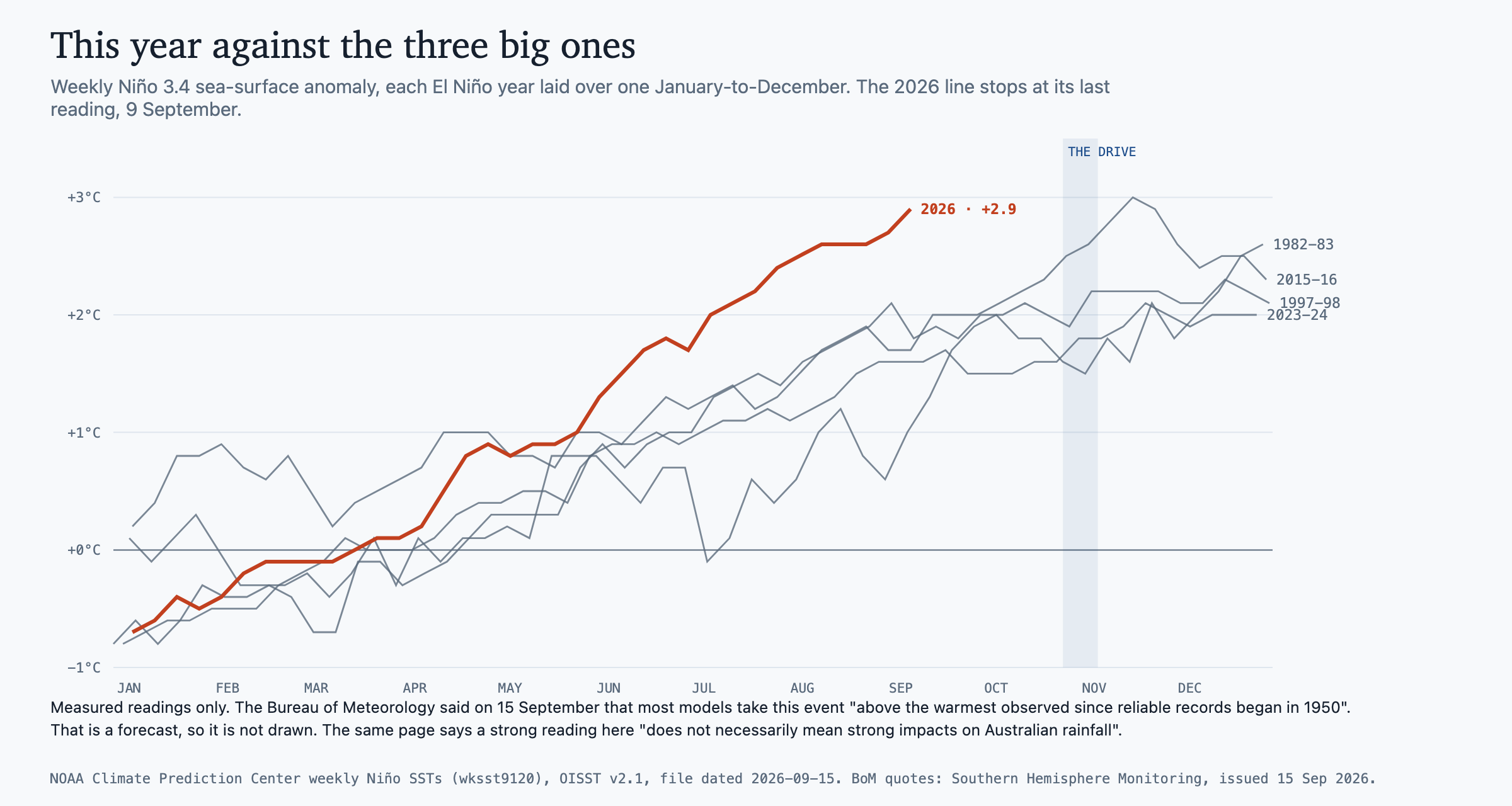
The same page carries the sentence the headlines leave out: a strong reading there "does not necessarily mean strong impacts on Australian rainfall and temperature; ENSO is only one of many factors."17 Both sentences are the Bureau's. Both are true at once. The forecast loads the dice. It does not throw them.
That is why the growers who made this year's decisions do not tell one story about it. A contractor's clients between Moree and Collarenebri did not plant: no subsoil moisture from the summer, "the cost of fuel and fertiliser, plus the forecast talking about El Niño."8 North of Goondiwindi the Beare family sowed wheat into dry ground in June because "confidence in forecasts has seen considerable areas planted ahead of rain."18 Same forecasting system, opposite decision. And at Griffith on the wet side of the line a grower spent $50,000 sowing for a predicted 30 millimetres that never came: "You can't go on a good forecast, you need the actual rain and puddles."19
I am not going to tell you which of them was right. The document that counts the tonnes never mentions the forecast at all, and the piece a former ABARES chief economist wrote for the general reader this week is about what the event will do to the price of broccoli and beef, not what it already did to a planting decision in April.20 That gap, between the ocean and the paddock, is the one this project is built to stand in.
The call
If you are on either side of the line, three questions, any of which you can answer in two lines.
- Is your paddock bare this spring, or did winter crop go in, and where?
- When does your header start, and is your crew here yet?
- Can I stand in your paddock for an hour between 27 October and 7 November?
Reply to this email, or write to me. Named or not, your call. Everything you send me is a lead until I can check it, and I say so when I use it. Prints go back to everyone who is in the pictures.
Three ways to take part.
Get the next one. The dispatches follow the forecast, the money and the field from here to the May 2027 harvest, free, from this site.
Pass this one on. Someone you know farms, trucks, brokers or counts on one side of this line, or is waiting on a visa to cut it. They will know what I have got wrong.
Bluesky X LinkedIn Facebook Email
Tell me where I am wrong. A number that does not match your document, a place I have misread, a person I should be talking to.
Notes
- ABARES, Australian Crop Report No. 219, 1 September 2026: winter crop "forecast to fall by 12% to 61 million tonnes," "16% above the 10-year average," "fourth largest on record"; Queensland "forecast to fall by 44% to 2.2 million tonnes," "a 9% downward revision from the June 2026 Australian Crop Report." https://www.agriculture.gov.au/abares/research-topics/agricultural-outlook/australian-crop-report/september-2026 ↩
- Report No. 219, New South Wales: "well below average soil moisture levels across much of northern New South Wales leading into spring ... are expected to significantly reduce yield prospects." ↩
- Gerard Doherty, Knight Commodities, Goondiwindi, in Liz Wells, "Feedgrain Focus: South feels weight of new crop," Grain Central, 10 September 2026 (Beef Central syndication 14 September). https://www.graincentral.com/markets/feedgrain-focus-south-feels-weight-of-new-crop/ ↩
- Same column: "Some locations recorded maximum daytime temperatures in excess of 30 degrees Celsius with drying winds last weekend, and for those crops with little to no moisture beneath them, yield potential has been lost"; "stressed crops could well be grazed or baled while they still have some biomass." ↩
- Digital Agriculture Services, media release, "Wheat area falls as barley gains ground across major grain states," 16 September 2026. https://blog.digitalagricultureservices.com/en-au/media-releases/wheat-area-falls-as-barley-gains-ground-across-major-grain-states ↩
- Robert Quinn, Stewart Grain, in Liz Wells, "Feedgrain Focus: Prices firm after dry fortnight," Grain Central, 17 September 2026. Also the source of "cracking in earnest," "expected to be a fast one," "pushing south," and the sorghum planting. https://www.graincentral.com/markets/feedgrain-focus-prices-firm-after-dry-fortnight/ ↩
- ABARES, Weekly Australian Climate, Water and Agricultural Update, 17 September 2026: "little to no rainfall was recorded across cropping regions in Queensland, and central and northern New South Wales"; "conditions are expected to be mostly dry across most cropping regions in South Australia, Victoria, New South Wales and Queensland" over the eight days to 24 September. https://www.agriculture.gov.au/sites/default/files/documents/WeeklyAustClimateWaterAglUpdate20260917.pdf ↩
- Liz Wells, "Two-speed harvest nears as contractors sweat on visa approvals," Grain Central, 24 August 2026. https://www.graincentral.com/news/two-speed-harvest-nears-as-contractors-sweat-on-visa-approvals/ ↩
- Direction 119, Order for considering and disposing of nominations and visa applications for certain Skilled Visas, Migration Act 1958 s 499, in effect 25 July 2026. It applies to subclasses 186, 187, 189, 190, 191, 482, 489, 491, 494, 887 and 888. https://immi.homeaffairs.gov.au/Visa-subsite/files/md-119.pdf ↩
- Department of Home Affairs, Working Holiday Maker program, latest news and status of country caps, as at 16 September 2026. https://immi.homeaffairs.gov.au/what-we-do/whm-program/latest-news ↩
- "Working holiday visa pause leaves farms short as harvest season looms," ABC News, 14 September 2026. https://www.abc.net.au/news/2026-09-14/working-holiday-visa-pause-leaves-farmers-short/107110194 ↩
- Jack Sorensen, Koondrook, in "Farmers lose workers to other countries amid visa delays," Stock & Land, 16 September 2026. https://www.stockandland.com.au/story/9350637/farmers-lose-workers-to-other-countries-amid-visa-delays/ ↩
- Tony Burke, Minister for Home Affairs, National Press Club speech, 17 September 2026, and media release "Migration reform to end rorts and bring in the skills Australia needs for a strong economy," 17 September 2026. Ballot figures: year two "limited to 45,000. For reference, last year there were 57,000 people who qualified"; year three 5,000. https://minister.homeaffairs.gov.au/TonyBurke/Pages/speech-national-press-club-17092026.aspx and https://minister.homeaffairs.gov.au/TonyBurke/Pages/migration-reform-end-rorts-bring-skills-australia-needs-strong-economy.aspx ↩
- Hamish McIntyre, National Farmers' Federation, 17 September 2026: "For many farms, three months is the difference between harvesting a crop and losing it." https://southburnett.com.au/news2/2026/09/17/nff-slams-visa-slowdown/ ↩
- Grain Producers Australia, media release, "Defence veterans answer the call again as harvest workforce pressure builds," 17 September 2026 (Matthew Madden, chair). https://www.grainproducers.com.au/post/defence-veterans-answer-the-call-again-as-havrest-workforce-pressure-builds ↩
- Terry Sim, "NFF rejects Albanese's 'right balance' claim on visa changes," Beef Central, 21 September 2026. https://www.beefcentral.com/news/nff-rejects-albaneses-right-balance-claim-on-visa-changes/ ↩
- Bureau of Meteorology, Southern Hemisphere Monitoring, issued 15 September 2026: relative Niño 3.4 "+2.51 °C" for the week ending 13 September; "Relative-Niño3.4 values are forecast to reach levels above the warmest observed since reliable records began in 1950, with the majority of models indicating a peak value above +3.0 °C"; "A strong El Niño signal in the Niño3.4 region does not necessarily mean strong impacts on Australian rainfall and temperature; ENSO is only one of many factors that can influence Australia's seasonal weather and climate." http://www.bom.gov.au/climate/enso/ ↩
- Liz Wells, "Feedgrain Focus: Season turnaround pressures prices," Grain Central, 11 June 2026. https://www.graincentral.com/markets/feedgrain-focus-season-turnaround-pressures-prices/ ↩
- "Drought-affected farmers welcome significant rainfall but some miss out," ABC News, 27 May 2026. https://www.abc.net.au/news/2026-05-27/drought-affected-farmers-welcome-rain-others-miss-out/106725944 ↩
- Don Gunasekera, "Will El Niño send food prices soaring this summer?", The Conversation, 17 September 2026. https://theconversation.com/will-el-nino-send-food-prices-soaring-this-summer-267430 ↩