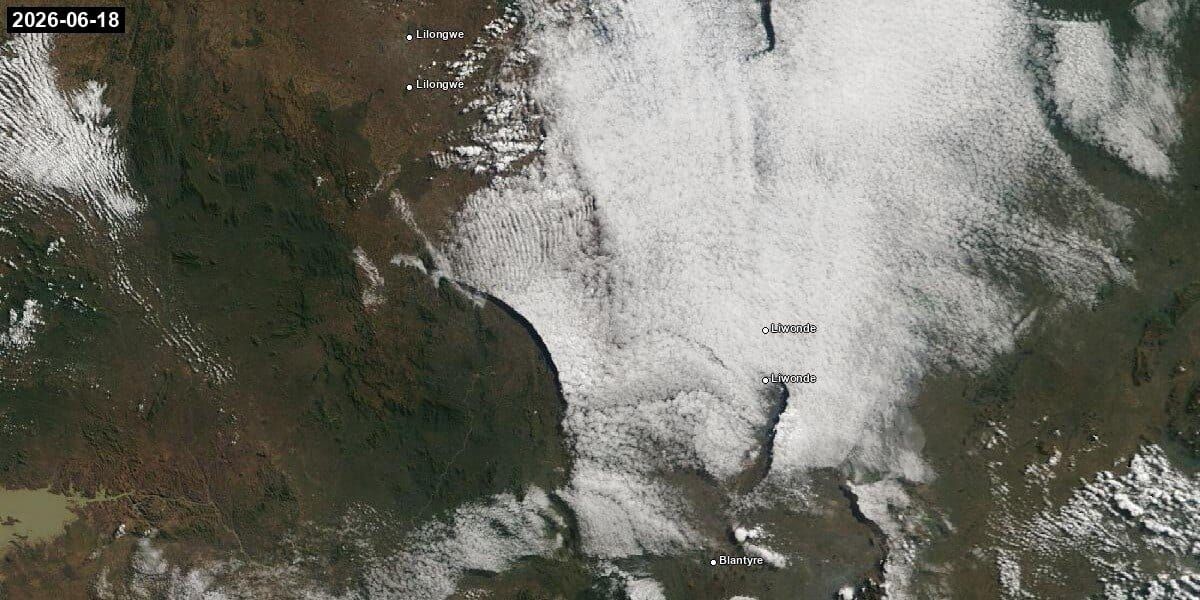
Dispatch 01 · On the Raggedy Edge · September 2026
On the 27th of August, in a conference centre in Swakopmund on the Namibian coast, a room full of meteorologists finished four days of work and published a document. It is sixteen pages long. It has a sponsor list (the World Food Programme, the UK Met Office, the FAO, the UN's disaster risk office, a water partnership) and it took inputs from most of the serious forecasting centres on Earth, ECMWF and NOAA and the Met Office and Tokyo and Beijing among them. Every national weather service in southern Africa sent people.
What they published is a forecast that most of the region's main rainy season will probably fail.
I've been building this project around that forecast for a month. Until the end of August it was a model output, a thing I could show you on a chart and argue about. Now it's a document with a date on it, issued by the body whose job it is to issue it. The warning exists. And I want to start this first dispatch by telling you how I nearly got the next part wrong.
It was heard
Three days after the statement came out I went looking for who had written it up, and I couldn't find much. A wire story out of Xinhua, one farm piece in a Malawian paper, nothing on ReliefWeb newer than last season. I drafted a section saying the warning wasn't being carried. Then I sat on it for a week and looked again, and the week made a liar of the draft.
Here's the record now, twelve days on. The Namibian had it the day it was published.1 Papers in Zambia, Zimbabwe and South Africa wrote it up over the following two days, most of them quoting the statement's own words and several of them keeping its caveats.2 The UN's humanitarian office issued a preparedness alert on the 28th, which puts the odds of a very strong event above ninety percent and says there's a seventy percent chance the October-to-December rains fall shorter than in any El Niño year since 1950. On the 1st of September the South African Weather Service put out its own statement. On the 2nd, Malawi's meteorological department released the national outlook, and the two Malawian papers I read carried it in full, maps and all.3 On the 3rd the government opened its climate outlook forum, with the minister telling the room that "a forecast such as this one is not a prophecy of hardship; it is an invitation to act early."4 On the 4th the British High Commission announced about three million dollars for preparedness.5 On the 5th the government published a costed plan.6
So the warning was carried, in the region, by the people it was written for. I'd rather tell you I was wrong than let a tidy line stand. What I still can't find, after twelve days, is any of the big international desks covering the forum itself. The BBC ran a global piece on the 3rd with the UN Secretary-General in it, and it reached for Botswana's last drought and Peru's coastline, but not for the sixteen pages from Swakopmund. The Guardian, Reuters, AP: nothing I can locate, though my search isn't exhaustive and I'll say so every time. The gap isn't attention in southern Africa. The gap is money, and I'll come to the size of it.
One thing from the first draft does survive. The Xinhua story said the forum had described the coming event as "the strongest in living memory." The statement doesn't contain that phrase. I checked every page. What happened next is the interesting part: five days later the South African Weather Service used exactly those words, in its own name, in its own statement, and added that the event "will very likely exceed the 3°C threshold." So the phrase is real and it has an owner. It just wasn't SADC, and it wasn't on the 27th.
What it actually says
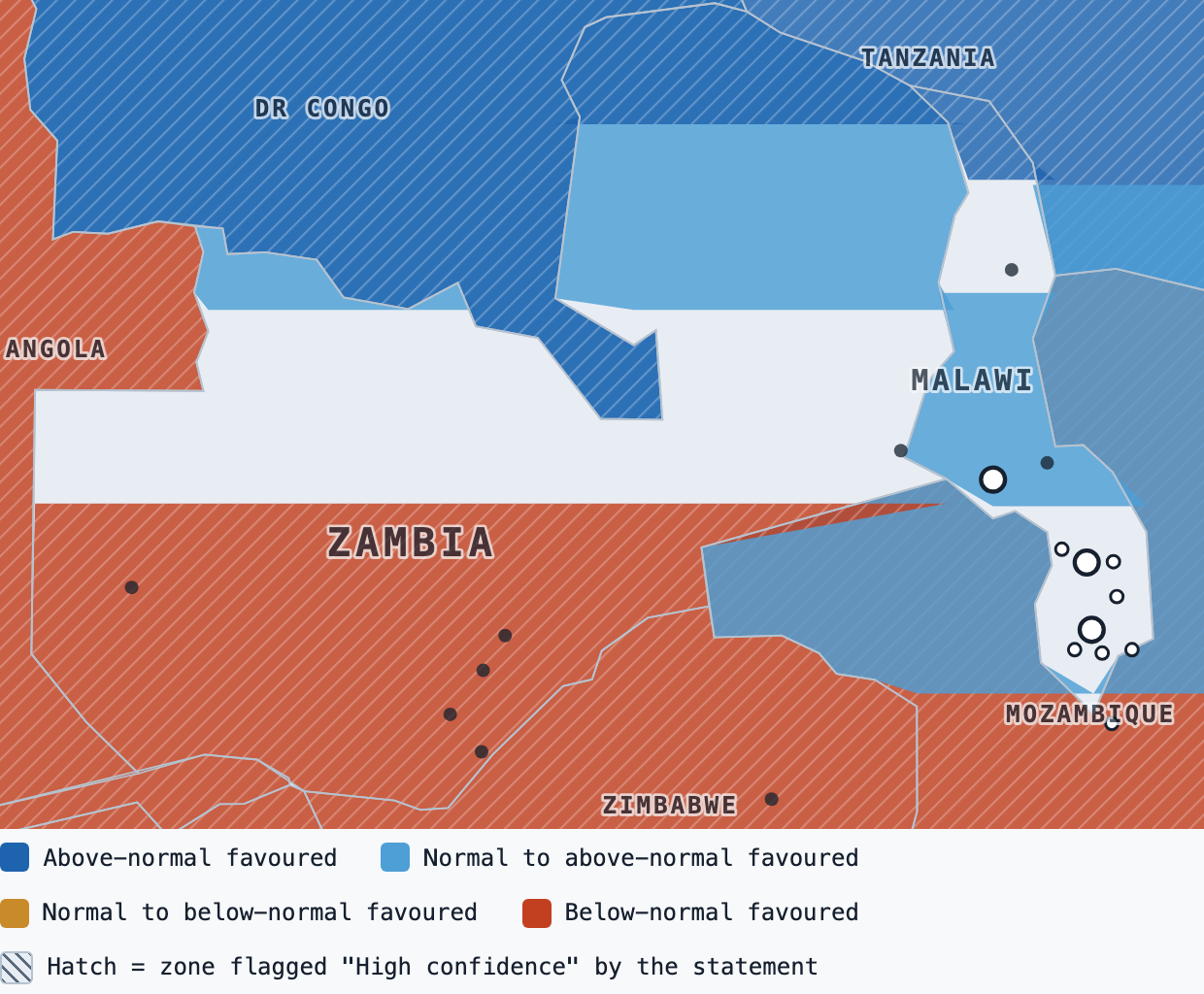
Not "southern Africa faces drought." That's the flattening, and the document is more interesting than that.
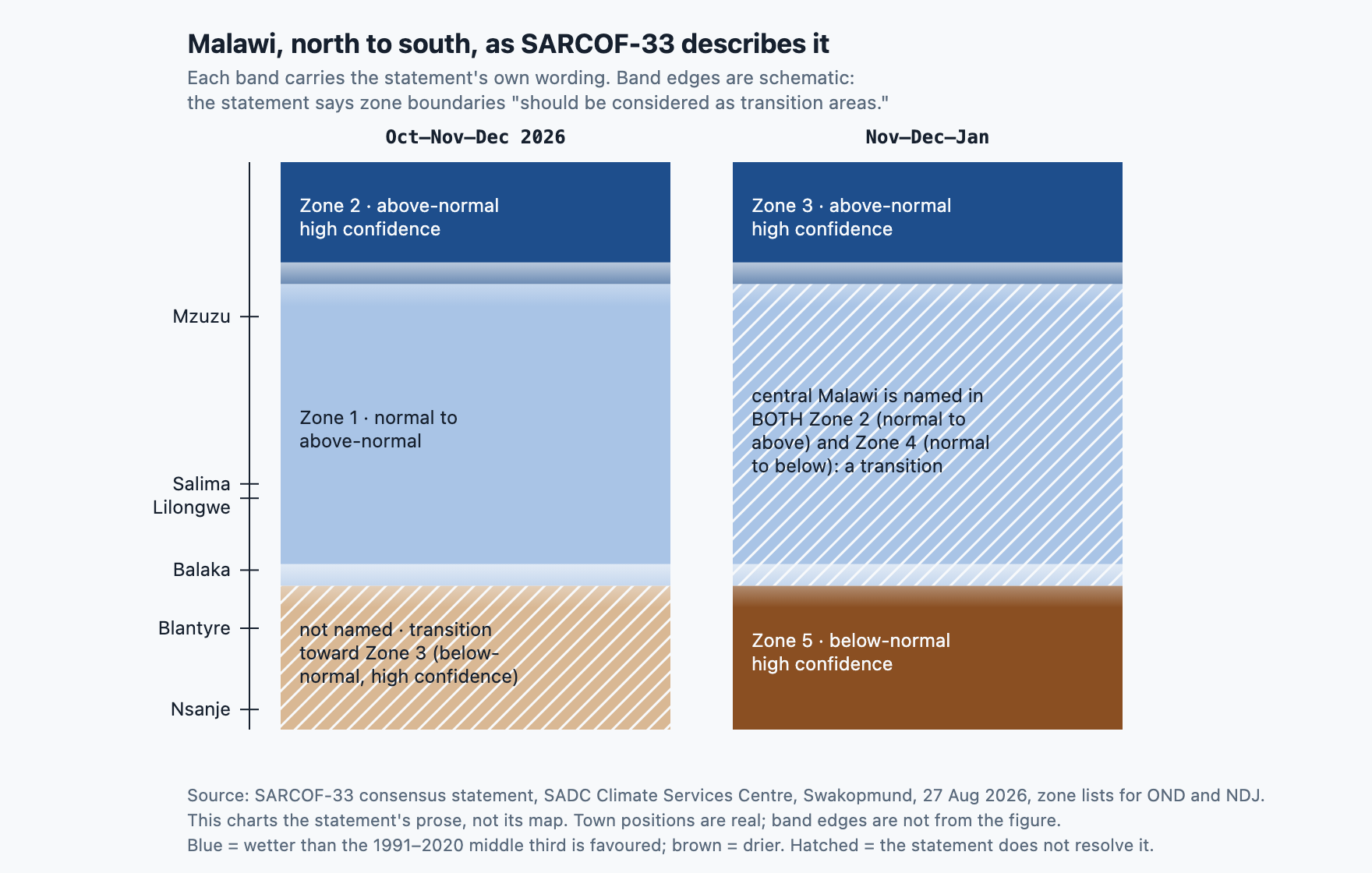
The forecast is drawn as zones on a map, and for October through December the map splits Malawi. The far north sits in a zone with "increased chances of above-normal rainfall," and the forum marks that high confidence. The centre, around Lilongwe where I'll land in December, is "normal to above-normal." The big dry zone, below-normal at high confidence, is named as "much of Angola, southern Zambia, Zimbabwe, Mozambique, Namibia, Botswana, most of South Africa, Eswatini and Lesotho." Southern Malawi isn't named in that October list. It sits in the transition toward the dry zone, wrapped by Mozambique on three sides, and by the November-to-January period it is named, plainly, on the dry side at high confidence.
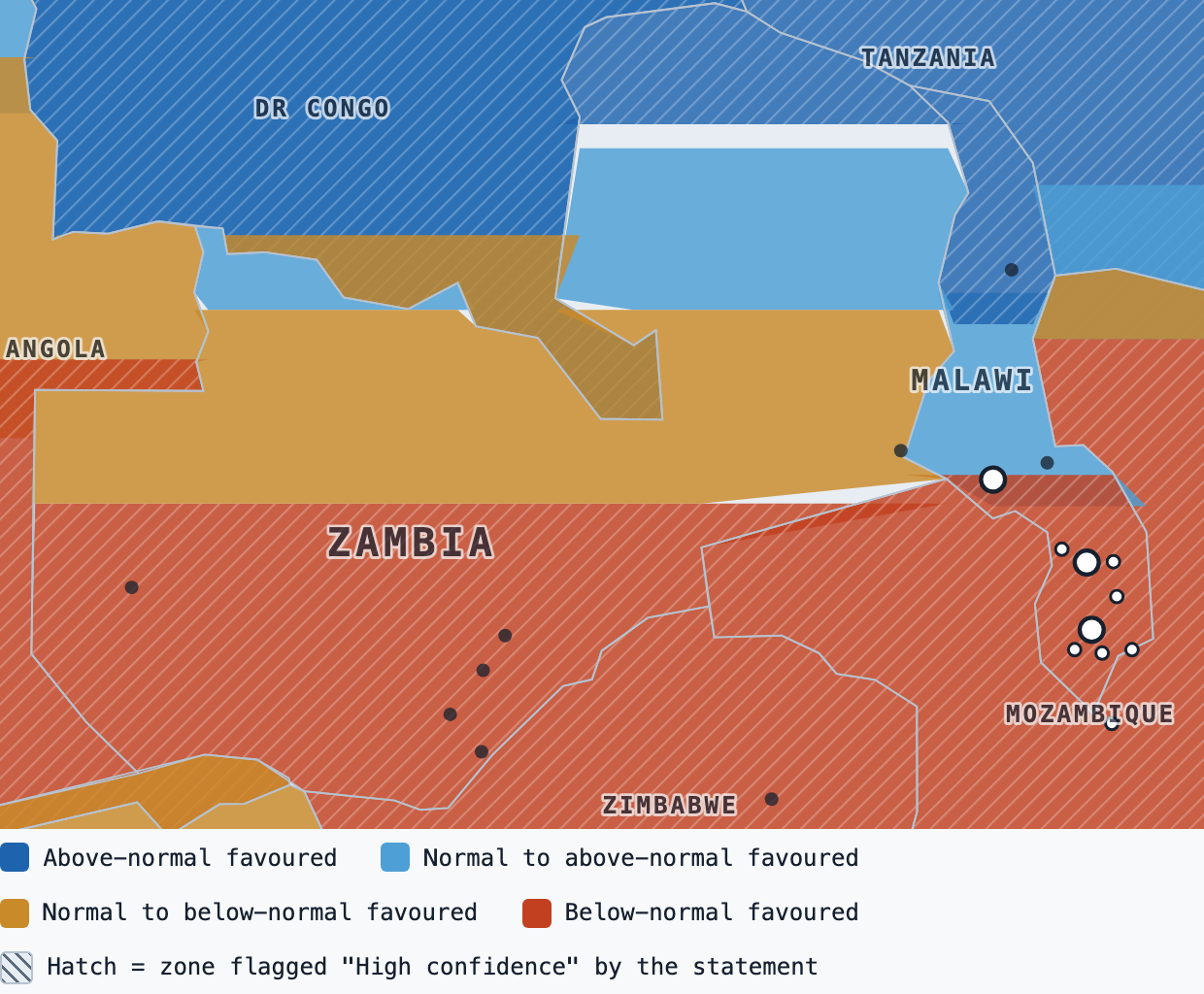
Then Malawi's own service went further. Its national outlook, released on the 2nd of September,7 says the risk of below-normal rain from October is "high in the Shire Valley, Thyolo, Blantyre, Mwanza, Neno, and Balaka." That is a list of the places this project works, and it's their list: a national service running its own downscaled forecast on its own station record, which is a different thing from a visitor dividing a continental model by a district's average. When I quote a district now, it's theirs. It expects the start of the rains to be "significantly delayed over the South," established rain from mid-December over most of the country, a growing season of 100 to 120 days in the south and centre against 110 to 140 in the north, and Lake Malawi to drop by twenty to thirty centimetres.
So the country I'm anchoring in runs wet in the north, normal in the middle, and drying from the south as the season goes on. A line, not a blanket. That's the picture, and it's the honest one.
The ocean, and the second thing in the water
The reading, which I'll put in the same place every issue so you can watch it move. Weekly sea surface temperature in the central Pacific, the Niño 3.4 box, is +2.7°C above normal for the week of 2 September.8 The official three-month index is +1.80 for June through August, up from +1.39 a month earlier.9 NOAA's status is El Niño Advisory, with better than a nine in ten chance of a very strong event this northern winter. The forum's own words: "a strong to very strong event, and peak intensity expected around the OND 2026 period."
And it isn't only the Pacific. The Indian Ocean Dipole is "currently neutral," but the forum sees "a high likelihood of a strong positive IOD developing by September 2026" and says outright that the region's rain "is not determined by ENSO alone." I'm going to hold myself to that too. If the forum won't tell a single-cause story, neither should I. The South African service makes the same point from the other side: the very strong El Niño of 1997/98 brought slightly above-normal rain to parts of South Africa. Most of them dry the region out. Not all.
Why planting, if the dry comes in January
This is the question I get asked, and it's a fair one. The forecast puts the districts I'm heading to on the wet side through October, and the dry signal in the south doesn't firm up until November-to-January. So why photograph planting?
Because a maize crop doesn't fail at planting and it doesn't fail at harvest. It fails at tasselling, the moment in January and February when the plant flowers and each silk has to be pollinated or the kernel never forms. Drought or heat right then and a field can look green and yield almost nothing. My own satellite series over Balaka, eleven years of it, peaks in February. The greenest and the most fragile moment of the year are the same week.
So planting is not when the season fails. Planting is when people commit seed and fertiliser and labour to a season they've now been told will probably fail, and told by their own government, in their own district's name, with the rains expected late. Malawi's own service now puts established onset from mid-December, which is why I go in December rather than November: I want to be there when the seed goes in, not weeks before. That's the photograph. The forecast is what makes it mean anything. And it's why I'm coming back in May, to the same households, for the harvest that results.
What's already true, before any of this arrives
The honest version of southern Malawi is that it's in trouble already, and this El Niño hasn't done anything yet. The food security agencies project 2.6 million people, about one in seven, in Crisis phase or worse through March 2027, and none in the two phases above that.10 The World Food Programme plans to feed about 600,000 of them in four southern districts from October, and says it is seventeen million dollars short for that alone.11 The government's fertiliser subsidy is cut by more than half this season, and a bag of fertiliser in a shop is running around two hundred thousand kwacha, up from a hundred and fifty thousand last year.12 American assistance to Malawi is down 59% from a year ago, in a country where the United States was six tenths of bilateral aid in 2024.13
Now put the government's own plan beside that. It costs preparing for this season at 488 billion kwacha, has found 164 billion, and names the gap: 325 billion, roughly 185 million dollars. The plan wants 440,000 tonnes of maize secured for the reserve, in a country short of the foreign exchange to buy it. The British money announced this week is about three million dollars. The warning was heard. The response is about a third funded.
The El Niño is forecast risk arriving on a system that's already been weakened. That's convergence, not causation, and I'm going to keep saying it that way because the other version wouldn't survive a second look.
The week the alarms went off
Here's the other thing the twelve days did. While the region was reading its forecast, a good part of the rest of the world was writing decrees.
Panama declared a national state of emergency by cabinet resolution on the 25th of August, with the Pacific side of the isthmus running about sixty percent short of rain, and by the 4th of September the canal authority had started cutting daily transits from thirty-six toward thirty-two.14 El Salvador went to a nationwide red alert for drought the same day as Panama; Honduras already had seventy-five municipalities under emergency.15 Ecuador's risk secretariat declared a red alert across all twenty-four provinces on the 29th, and two days later the president signed a decree putting nine ministries behind it, with 650 million dollars and 1.3 million people named as exposed.16 Peru, on the 1st of September, put 893 districts in twenty-two regions and Callao under a sixty-day state of emergency by supreme decree, a level-four declaration, which in Peru's system means the regions have formally said they cannot handle it alone. Its own ocean commission now gives better than even odds of an extraordinary coastal event.17 On the same side of the Pacific the United States is sending a hospital ship to the Peruvian coast for the peak.18
In the east, Kenya's Red Cross sounded a fresh flood alert on the 6th,19 Somalia's disaster agency was in Beledweyne on the 5th for the same reason,20 and a Tanzanian lake city activated its emergency plan on the 7th.21 Indonesia is fighting more than a hundred thousand hectares of fire in a dry season that has run long. Los Angeles County's emergency managers are prepping for a wet winter.22 On the 3rd the UN Secretary-General said the world had entered "a danger zone of extreme weather," and the WMO put the odds of the event lasting into February at close to certain.23
And in the region this dispatch is about: Zimbabwe's cabinet has a six-pillar plan and spent this week walking a hundred district directors through it in Harare.24 Malawi's president has a cabinet committee, a costed plan and a third of the money. Zambia's disaster unit is being told by its own NGOs not to mistake a record harvest for a cushion.25
So the warning exists, and the warning was heard, and the alarms went off in a dozen countries in one week. What none of those decrees can do is make it rain in Balaka, or pay for the maize Malawi says it needs to buy. The gap between a warning issued in August and a decision made at planting is the story. People are standing in it now. Lilongwe in December; the same fields again in May.
Three ways to take part.
Get the next one. The dispatches follow the forecast, the money and the field from here to the May 2027 harvest, free, from this site.
Pass this one on. A forecast that was heard in Lilongwe and Lima has not been heard in most of the places that read this.
Bluesky X LinkedIn Facebook Email
Tell me where I am wrong. A number that does not match your document, a place I have misread, a person I should be talking to.
Notes
- The Namibian, "SADC braces for a dry, hot rainy season," 27 August 2026. https://www.namibian.com.na/sadc-braces-for-a-dry-hot-rainy-season/ ↩
- Among them Zambia 24 (28 August), The Villager (31 August), the Mail & Guardian (29 August) and Zimbabwe Situation (30 August). SADC's own press release of 27 August is at https://sadc.int/sites/default/files/2026-08/PRESS%20RELEASE%20SARCOF-33-27%20Aug.pdf ↩
- Maravi Express, 2 September 2026, which carries the DCCMS outlook text and maps: https://www.maraviexpress.com/the-2026-2027-rainfall-outlook-indicates-high-chance-of-below-normal-rainfall-over-most-areas-of-southern-and-central-regions/ and Malawi24, "Drier rains ahead: South, Centre at higher risk," https://malawi24.com/2026/09/02/drier-rains-ahead-south-centre-at-higher-risk/ ↩
- Minister of Natural Resources Patricia Wiskes at the fifth National Climate Outlook Forum, Lilongwe, 2 September, as reported by The Nation: https://mwnation.com/uk-pumps-k5-3bn-into-malawis-el-nino-preps/ and Nyasa Times: https://www.nyasatimes.com/malawi-govt-launches-2026-2027-climate-outlook-forum-calls-for-early-preparedness-amid-el-nino-risk/ ↩
- The Nation, "UK pumps K5.3bn into Malawi's El Niño preps," 4 September 2026, quoting Deputy High Commissioner Ben Nicholson: "approximately over three million US dollars." https://mwnation.com/uk-pumps-k5-3bn-into-malawis-el-nino-preps/ ↩
- Government statement signed by Chief Secretary Justin Saidi, chair of the Ad Hoc Cabinet Committee on El Niño, carried by Maravi Express (4 September) and The Nation, "Malawi faces K324.8bn gap in El Niño preparedness," 6 September 2026. https://mwnation.com/malawi-faces-k324-8bn-gapin-el-nino-preparedness/ ↩
- The outlook PDF was not yet on the department's site when this was written; the wording here is as carried in full by Maravi Express (note 3). Department of Climate Change and Meteorological Services: https://www.metmalawi.gov.mw/products/seasonal-climate-outlook/ ↩
- NOAA Climate Prediction Center weekly Niño SST indices, 1991 to 2020 base: https://www.cpc.ncep.noaa.gov/data/indices/wksst9120.for ↩
- Oceanic Niño Index, NOAA Climate Prediction Center: https://www.cpc.ncep.noaa.gov/products/analysis_monitoring/ensostuff/ONI_v5.php ↩
- Malawi IPC acute food insecurity analysis, projection period October 2026 to March 2027, 2,612,671 people in Phase 3 or above, via the IPC and the Humanitarian Data Exchange: https://www.ipcinfo.org/ ; FEWS NET's Southern Africa outlook of June 2026 reaches the same reading for southern Malawi: https://fews.net/southern-africa/food-security-outlook/june-2026 ↩
- The Nation, "WFP to feed 600 000 in lean season response," 31 August 2026, on WFP's August 2026 Malawi country brief. https://mwnation.com/wfp-to-feed-600-000-inlean-season-response/ ↩
- The Nation, "High costs, dry skies mar farming season countdown," 2 September 2026: spot checks of K180,000 to K205,000 a bag. https://mwnation.com/high-costs-dry-skies-mar-farming-season-countdown/ ↩
- OECD DAC2A bilateral ODA to Malawi, 2024, and US foreign assistance disbursements to Malawi, fiscal 2025 against 2024; the subsidy figure is the 2026/27 budget allocation for the Affordable Inputs Programme against 2025/26. Sources and workings are in the project's aid and inputs notes; a public link for each will be added before send. ↩
- Phys.org, "El Niño and the Panama Canal," 3 September 2026, on the Canal Authority's transit reduction: https://phys.org/news/2026-09-el-nino-panama-canal.html ↩
- News Central (with Reuters), 25 August 2026: https://newscentraltv.com/panama-declares-emergency-as-el-nino-worsens/ ; Honduras figures as of 21 August per regional reporting. ↩
- El Mercurio (Cuenca), "Ecuador en Alerta Roja por el fenómeno de El Niño," 31 August 2026: https://elmercurio.com.ec/nacional/2026/08/31/ecuador-en-alerta-roja-por-el-fenomeno-de-el-nino/ ; teleSUR English on the SNGR figures: https://www.telesurenglish.net/ecuador-red-alert-el-nino-evolve/ ↩
- ENFEN Comunicado Oficial 15-2026, 28 August 2026: at least 62% probability of an extraordinary coastal El Niño between September 2026 and January 2027. Andina on the decree: https://andina.pe/ingles/noticia-peru-govt-declares-state-of-emergency-in-several-regions-over-nino-rainfall-danger-1090011.aspx ↩
- BBC, "UN warns of 'supersized' El Niño as countries prepare for impact," 3 September 2026: https://www.bbc.com/news/articles/c17jqp0xzpzo ↩
- Kenyans.co.ke, "Kenya Red Cross warns 2 million people could be affected by El Niño rains," 6 September 2026: https://www.kenyans.co.ke/news/126826-kenya-red-cross-warns-2-million-people-could-be-affected-el-nino-rains ↩
- SONNA, "SoDMA Chief arrives in Beledweyne," 5 September 2026: https://sonna.so/en/article/SoDMA-Chief-Arrives-in-Beledweyne-to-Strengthen-Flood-Preparedness-and-Emergency-Response ↩
- Daily News (Tanzania), "Flood-prone residents urged to relocate," 7 September 2026: https://dailynews.co.tz/flood-prone-residents-urged-to-relocate/ ; The Chanzo on the national plan, 2 September: https://thechanzo.com/2026/09/02/inside-tanzanias-el-nino-emergency-plan/ ↩
- LAist, 1 September 2026: https://laist.com/news/climate-environment/la-county-emergency-managers-rush-to-prepare-for-el-nino ↩
- WMO El Niño/La Niña Update of 3 September, as reported by the Mail & Guardian, 4 September 2026: https://mg.co.za/the-green-guardian/2026-09-04-el-nino-set-to-strengthen-into-very-strong-event-wmo-says/ ↩
- Bindura Eye, "Government outlines six-pillar plan as Super El Niño threatens 2026/27 crops," 6 September 2026: https://binduraeye.co.zw/government-outlines-six-pillar-plan-as-super-el-nino-threatens-2026-27-crops/ ↩
- Lusaka Times, "Zambians cautioned against looming El Niño," 1 September 2026: https://www.lusakatimes.com/2026/09/01/zambians-cautioned-against-looming-el-nino/ ↩